.png)
Posing is at the heart of Poser — it’s what the software was originally designed for, and it remains one of the most joyful, creative parts of the entire workflow. Going back to basics and using Poser as the powerful posing tool it was intended to be can feel incredibly refreshing, especially in a world overflowing with ready‑made content. While prebuilt poses are convenient, creating your own is where the magic happens. Your poses become unique, personal, and unmistakably yours. This guide walks you through the fundamentals of natural, expressive posing so you can build confidence, develop your eye, and rediscover the fun of shaping characters from the ground up.
Start With the Whole Body, Not the Limbs
When beginning a pose, think of your character like an action figure: you start by arranging the major body blocks — the hips, chest, and head — before worrying about the smaller parts. Establishing the overall gesture first helps you define the character’s intention and energy. If you jump straight into posing arms or legs in isolation, the result often feels stiff or unbalanced because the limbs don’t relate naturally to the body’s core movement. Save the fingers, toes, and fine adjustments for later; they’re the polish, not the foundation.
Keep the Character Balanced
A convincing pose starts with believable weight distribution. Imagine dropping a vertical line from the character’s head straight down to the floor — does it land between the feet? If it does, the pose will feel grounded and stable. If not, the character may appear to be tipping, floating, or defying gravity unintentionally. Many artists often overlook the hips and feet, which can lead to “weightless” poses. Unless your character is meant to be mid‑air, make sure their stance reflects real‑world balance.
Add a Little Asymmetry
Humans rarely stand in perfectly mirrored positions, and adding even a touch of asymmetry can instantly make your pose feel more natural. Try raising one shoulder slightly, shifting a hip, or bending one knee more than the other. These subtle variations introduce personality and realism without requiring complex adjustments. Symmetry is great for robots or mannequins, but for human characters, asymmetry is the secret ingredient that brings life into the pose.
Keep Joints Within Natural Ranges — Turn Limits On
Joint limits exist for a reason: they help you stay within believable anatomical ranges. Start by rotating limbs from the major joints — the shoulders and hips — before refining with elbows, knees, wrists, and ankles. This top‑down approach keeps the pose cohesive and prevents awkward angles. Avoid extreme twists or bends that break anatomy or cause mesh distortion. If a joint looks painful or unnatural, ease it back. Turning joint limits on is especially helpful for beginners, as it keeps the figure behaving like a real body.
Give the Spine Some Life
The spine is the emotional core of a pose. A slight curve can communicate confidence, curiosity, fatigue, or attitude. Combining rotation, bend, and side‑to‑side movement creates an organic flow that instantly elevates the pose. Even a tiny adjustment can transform a neutral stance into something expressive. Straight, rigid spines tend to look artificial unless you’re intentionally posing a mannequin or a character meant to appear stiff. Let the spine breathe — it’s where much of the character’s personality lives.
Hands and Feet Matter More Than You Think
Hands and feet are often the last things beginners adjust, but they have a huge impact on the believability of a pose. Relax the fingers into a gentle curl instead of leaving them flat or stiff. Adjust the feet with a slight inward or outward angle to reflect mood or personality. These small touches add polish and help your character feel grounded in the scene. Avoid perfectly straight fingers or parallel feet unless the pose specifically calls for it.
Use the Head and Eyes to Show Emotion
A slight tilt of the head can completely change the mood of a pose. Tilt it forward for shyness, back for confidence, or sideways for curiosity. Pair this with eye direction that matches the character’s focus — whether they’re looking at another character, an object, or something off‑screen. Avoid neutral, straight‑ahead stares unless the scene requires it. The head and eyes are where your pose truly comes alive, because they communicate intention more clearly than any other part of the body.
Check the Silhouette
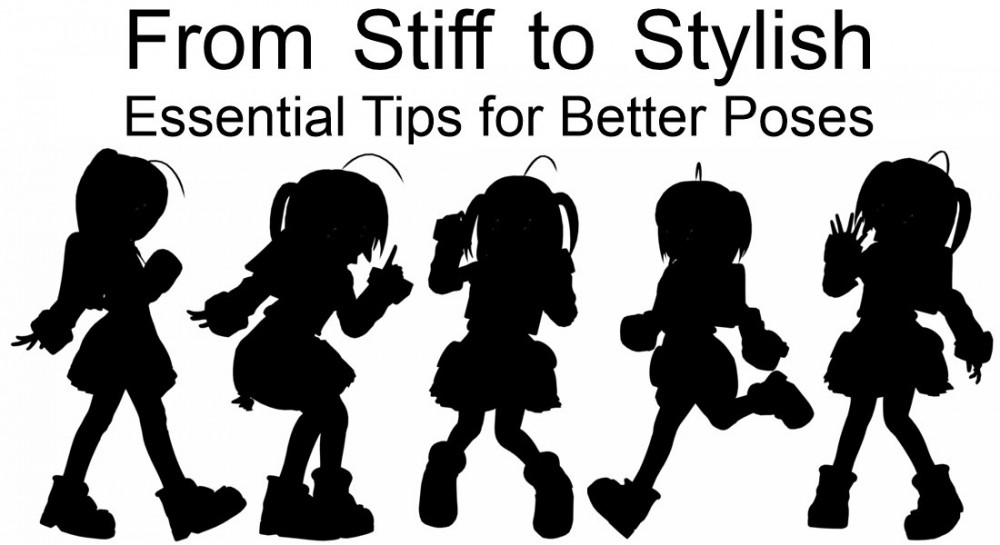
A strong silhouette ensures your pose reads clearly from a distance or in low detail. Switch to a simple lighting setup or backlit view and look at the outline of your character. If the shape is clear and expressive, you’re on the right track. If limbs blend into the torso or the pose looks muddled, adjust the arms or legs to create more separation. A readable silhouette is one of the most reliable indicators of a successful pose.
Don’t Be Afraid to Exaggerate
Once your pose looks good, try pushing it just a little further. A slightly deeper bend, a more pronounced twist, or a stronger tilt can add clarity and energy, especially in stylized or narrative scenes. Beginners often stop too early because they’re afraid of “breaking” the pose, but gentle exaggeration is a powerful artistic tool. It helps your character feel intentional rather than accidental, and it adds visual interest without requiring advanced skills.
Use Reference — It’s Not Cheating
Reference is one of the most valuable tools you can use. Look at photos, mirror yourself, or take quick snapshots to study how real bodies hold weight and express emotion. Reference helps you understand balance, anatomy, and gesture in ways that guessing never will. Adapt what you see to your character’s proportions and personality rather than copying it exactly. Tracing a reference pose too literally can look uncanny in 3D, but using reference as inspiration leads to stronger, more believable results.
Creating your own poses is one of the most rewarding ways to use Poser. It brings you back to the software’s roots — back to basics, back to creativity, back to using Poser as the posing tool it was always meant to be. Ready‑made poses have their place, but when you craft your own, you’re building something unique, expressive, and unmistakably yours. Every pose becomes a small act of storytelling, shaped by your eye, your instincts, and your imagination. That’s the real joy of Poser.